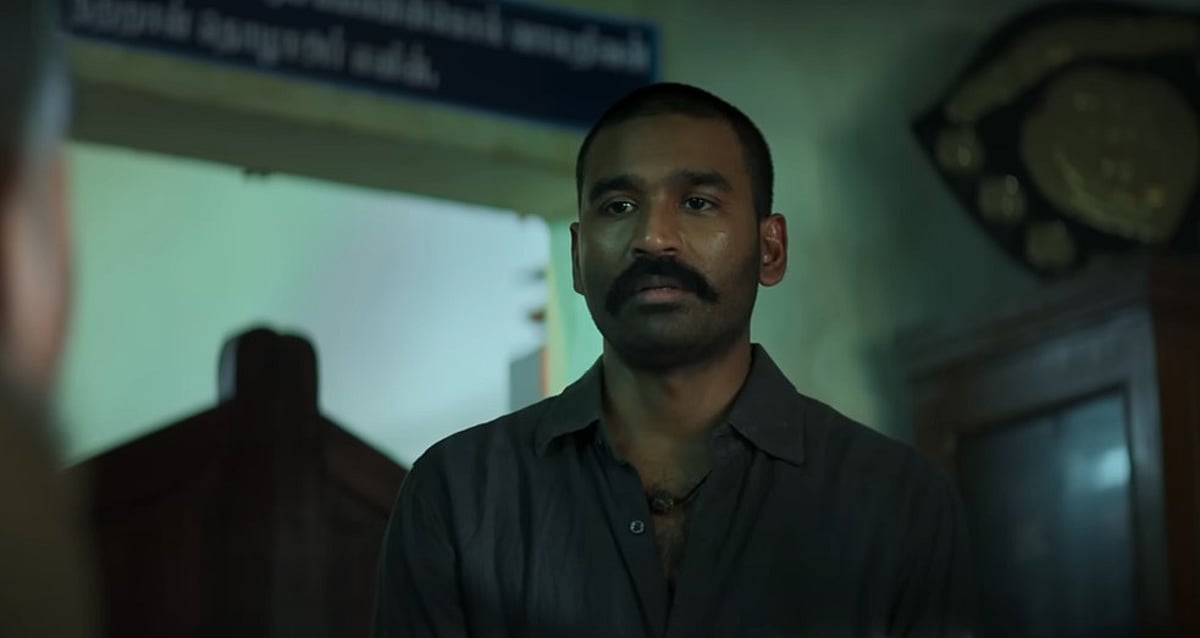
Well before director Dhanush presents us the ten-headed Raavana image of Raayan (played by Dhanush himself), there is plenty of reason to process the protagonist as a reimagination of the demon-god. He has got a sister he dotes on, a feisty sister who is quite capable of fighting her battles. He has got a couple of brothers, one of who seems more noble than the other, one of who feels more traitorous than the other. Raayan and co. feel like a family of asuras, a clan whose bloodline seems prone to violence, each of them being naturally gifted at mayhem-making. Perhaps that’s why towards the end, a mother hands over a baby, saying, “Unga raththam enakku vendaam.” Perhaps the idea for the story itself began with a what if. What if we threw a family of asuras into present-day civilisation? What if we threw them into a mix of poverty, social neglect and lawlessness?
The parents of Raayan and siblings step out, never to return. In suffering, Raayan turns to a deity-figure, as you’d expect, but then, when has God, in our mythology, taken the side of asuras? For that reason, he is the first to get murdered here. Someone quips, “Poojari, la… Adhaan kadavul kitta poitaaru.” From then on, it’s a quest for survival for the Raayan family. Unlike Kokki Kumar, who stood for the ‘survival of the fittest’, Raayan’s idea of survival isn’t predicated on climbing up the ladder of ambition. He’s smarter; he’s more grounded. He prefers to keep his head down and keep his family together, and as we see his siblings oriented towards specific goals (education for Muthu, marriage for Durga), if you squinted, you could maybe even see a bit of Baasha in Raayan. At one point, he frightens a man into submission, and a cop asks, “Enna sonninga?” I half-expected him to say, “Unmaya sonnen.” But Raayan says, “Kenji ketten sir.” It’s one of many places in Raayan where director Dhanush shows that his goal isn’t to capitalise on easy mass-ification of his character.
Raayan is a fascinating character—and is likened to a lion in the film. Much like the animal, he kills with his ‘claw’—and it leads to some imaginative fight scenes. Much like a lion, he operates in solitude; he’s quiet with his kills, and he has limitless patience when his pride of siblings bother him. Dhanush plays him magnificently. When he willingly walks into the lair of wolves (as he goes to meet SJ Suryah’s Sethu), he struts every bit like a lion. When he sizes up his prey, his eyes brim with menace and bloodlust.
Through Raayan and Durga, director Dhanush presents the beauty of a selfless relationship where one never lets the other down. Isn’t that the stuff of poetry—to find someone who is ready to sacrifice themselves for you, someone for whom you’d willingly sacrifice yourself? Such a relationship fights the selfishness encoded into our biological being—and yet, every now and then, a special love emerges that shatters primal survival instincts. Raayan and Durga can forgive the harm done to themselves, but when it’s done to the other… There’s a lovely scene where they even verbalise this sentiment.