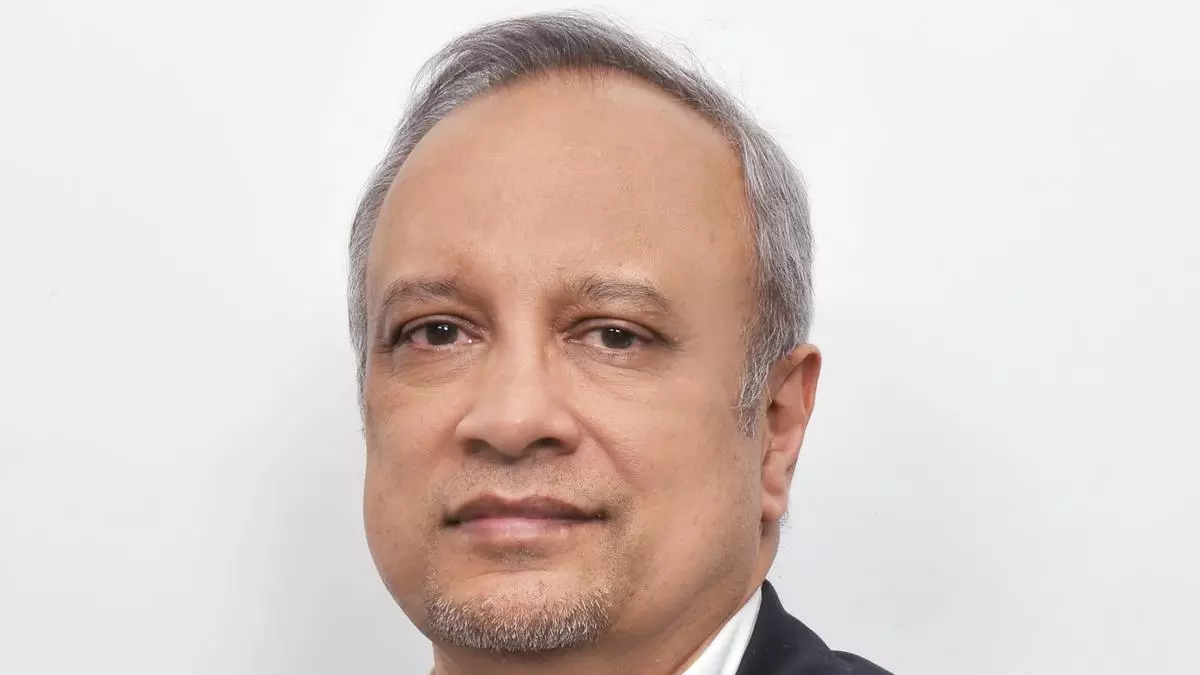
A multilingual internet could address many practical challenges for non-English communities, said Samiran Gupta, Vice President, Stakeholder Engagement and Managing Director at Internet Corporation for Assigned Names and Numbers (ICANN), Asia Pacific, adding that the Covid-19 lockdown period highlighted the need for top-level domains (.com, .org) in regional languages. In an interview with businessline, he talked about the economic benefits from such a change and other developments on ICANN’s end.
Why has ICANN decided to work towards non-Latin scripts? Have there been any limitations in the Latin script?
No, it’s the other way around. There were limitations in making the internet multilingual in the past. When the initial set of programming happened, all of that was done by people who use the Latin scripts. So, all the programming got done using those scripts. If you want to have, say a website, which has a top-level domain, right off the top, in a non-Latin script, there are some technological challenges, almost all of which have now been dealt with.
What are these challenges in not having non-Latin scripts in domain names?
It’s called the challenge of universal acceptance. For example, if you go to a website with Hindi content on it, the top-level domain will still be in English. This makes it challenging for web crawlers to find information. Similarly, if you go the IRCTC website, they have options of several languages but one box but it does not accept non-Latin script email ids. So, even if you actually have a “.भारत“ email id, you can’t book a railway ticket with it. If you go beyond the first 300-400 million population, then this single script becomes a challenge. We saw this challenge play out during Covid-19 pandemic when lockdowns were announced. Migrant workers were stuck all over the country and many didn’t know English. All governments had schemes and plans for food, medical support, etc but workers were unable to use those resources effectively. In a multilingual society, we don’t appreciate the challenges of those who can’t read and write multiple languages. The larger goal of all of this is to make the internet more multilingual.
What would be some of the benefits of a multilingual internet?
The biggest advantage is everybody can use the internet in their own language, no matter how small a country may be. Access to content in the language of choice means you’re also able to preserve the culture of that community. From an economic perspective, a study conducted 8-9 years ago found that the economic benefit of having a multilingual internet was a few billion dollars annually, due to the processing of additional information. The other thing is domains like .tokyo exists, .london exist businesses use. So, there are economic values associated with domain names of different scripts, signifying a location. There is also brand protection. There is .sony but then imagine an Indian brand, which sells products and it packaging is the same, but the script on the packaging keeps changing and goes to different scripts, depending on where they’re selling. So, they can use this online branding to further business.
What is ICANN doing towards this end?
We have the Applicant Support Program-ASP, a new feature for the next round and the Registry Services Providers Program-RSP. We had an ASP program in 2012, but we didn’t get enough applications. Now this ASP supports upto 40 odd applications. We opened on November 19 and so far received 19 applications. What we intend to do is to, for each applicant is to coach them on how you can use and run this top-level domain. By being enrolled in the ASP, if you get through the evaluation post-April 2026, then we will reduce up to 75-80% of the application fee, although the percentage may change. The RSP program is a technical evaluation program for existing registries or new registries who may want to run a registry operation for multiple top level domains.
ICANN had released an Internet Coordination Policy 2 regarding Regional Internet Registries. India had raised concerns on the policy suggesting to keep the RIRs to a small number. What is ICANN’s response on this?
This is a consultative process, nothing is finalized. ICANN propagates IP addresses and then blocks off those IP addresses which go to the RIRs. So the Indian Registry for Internet Names and Numbers, which is part of the National Internet Exchange of India, gets a block from us. It’s not like it is not getting blocks, but NIXI obviously uses it for “.in” and “.भारत,” which is fair. Now, if you want to have more RIRs, the standard operating procedures for running an RIR is a fairly high-level issue. The numbering system is directly related to the root zone of the internet. So yes, this is an ongoing conversation. We are seeking perspectives from organizations and users across the world and at some point, this will become a point of discussion in some of the key core committees of ICANN and then some decision will be taken.
ICANN had plans to set up these separate root server clusters in India. Is there any update on that?
We’ve been evaluating setting up root server clusters on the basis of the very high volume of usage of the internet, data traffic in the country and India’s huge geographic size. So, we are looking for the best design for India but we’ve not been able to decide on what is the best design. So while we were looking at that, we are now looking at alternatives to that as well, okay. So it may not be a cluster. It could be a network of single instances. There are 63 instances across India. Whether you go to the main root server or go to the instance, the core functions remain the same: to push traffic across. The main purpose of an instance is to reduce latency. Otherwise, the few root servers would get overburdened by a lot of queries. Globally, there are about 1500 odd instances and new ones are coming up from time to time. We are in talks with the government and we are hoping that this year we will be able to move forward on it.
Published on January 29, 2025